
If you have searched for “how much does a website cost” recently, you have probably come away more confused than when you started.
One article says $500. Another says $50,000. A freelancer quoted you $800. An agency sent a proposal for $12,000. And someone in a Facebook group told you they built theirs for free on Wix.
Who is right?
The honest answer is: all of them, depending on what you actually need. Website costs in 2026 range from almost nothing to hundreds of thousands of dollars — and that wide range is not a scam or a mystery. It reflects the fact that “a website” means something completely different depending on your business, your goals, and who builds it.
This post is going to cut through all of that. By the time you finish reading, you will know exactly what different types of websites cost, what drives the price up or down, and how to avoid the mistakes that cause business owners to spend money on the wrong thing.
Why Website Prices Vary So Much
Before getting into specific numbers, it helps to understand the variables that actually determine what a website costs. There are five main ones.
Who builds it. You can build a website yourself using a drag-and-drop platform, hire a freelance web designer, or commission a full-service agency. Each path has a completely different cost structure, skill requirement, and outcome.
What platform it is built on. A website on Squarespace has a very different cost profile from one built on WordPress, which is different again from a fully custom-coded site. Platform choice affects both upfront cost and ongoing monthly expenses.
How many pages it needs. A clean five-page service website costs significantly less than a thirty-page site with individual landing pages, a blog, a resource library, and location-specific pages.
What functionality it requires. A simple contact form is included in almost every platform. An online booking system, eCommerce store, membership portal, or custom calculator — these add complexity and cost.
The quality of the content. Many business owners overlook this entirely. The copy, photography, and brand assets that go into a website are often as expensive as the design itself — and they are what actually determine whether the site converts visitors into clients.
With those variables in mind, let us look at what each option actually costs in 2026.
Option 1: DIY Website Builders
Typical cost: $200 – $800 per year
Platforms like Wix, Squarespace, and Webflow allow you to build a website yourself using templates and a drag-and-drop editor. You pay a monthly or annual subscription that covers hosting, security, and the platform itself.
This is the most affordable entry point, and for the right business in the right situation, it is a completely legitimate choice. If you are in the very early stages of your business, testing an idea, or simply need a basic online presence to point people to, a DIY website can get the job done.
However, there are real limitations that most guides do not talk about honestly enough.
The first is time. Building a professional-looking website yourself — even on a platform designed to be easy — takes considerably longer than most people expect. Selecting a template, customising it to your brand, writing all the copy, sourcing or shooting photos, setting up pages, configuring a contact form, and connecting your domain is easily a forty-hour project for someone who has never done it before. For a business owner whose time has real monetary value, that time cost often exceeds what a freelancer would have charged.
The second is conversion. A DIY website that looks good is not the same as a website that converts visitors into enquiries and clients. Good conversion design requires an understanding of user psychology, page structure, copywriting, and technical SEO — none of which comes standard in a website builder template. Many business owners build a DIY site, wonder why it generates no enquiries, and eventually end up hiring a professional anyway — at additional cost.
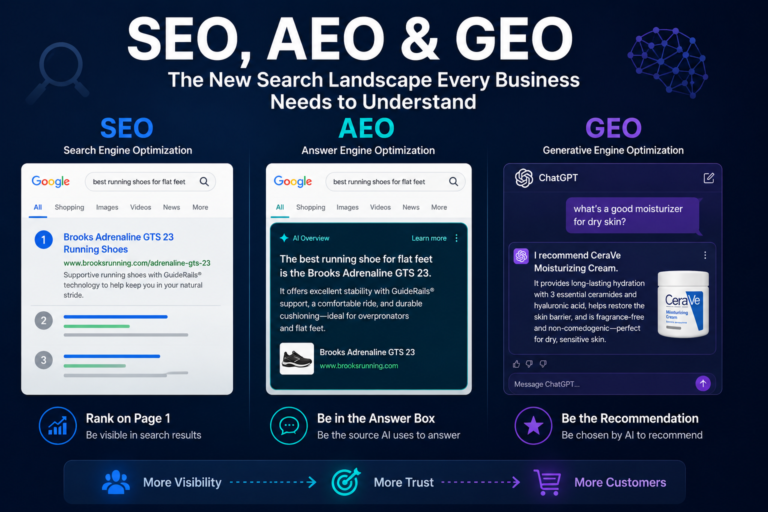
The third is SEO. While most website builders have improved their SEO capabilities significantly, they still have structural limitations compared to a well-built WordPress site. If ranking on Google is part of your growth strategy — and it should be — a DIY builder may create a ceiling on what you can achieve.
Best for: Pre-revenue businesses, solo founders testing a concept, or anyone who genuinely has more time than budget and is comfortable with technology.
Option 2: Freelance Web Designer
Typical cost: $1,500 – $8,000 for a complete website build
Hiring a freelance web designer or developer gives you a professionally built website without the agency price tag. For most small and medium-sized businesses, this is the sweet spot — you get expert guidance on strategy, layout, mobile optimisation, and SEO, at a cost that is realistic for the stage of business you are in.
Within the freelance range, pricing varies considerably based on experience level and scope.
A newer freelancer or one based in a market with lower labour costs might charge $1,500 to $3,000 for a professional five-to-eight page WordPress website. An experienced freelancer with a strong portfolio and proven results typically charges $3,000 to $8,000 for a comparable project — and the difference in outcome is usually significant.
The most important thing to understand when hiring a freelancer is that you are not just paying for a finished product. You are paying for strategy. A good freelance web designer will ask about your target audience, your competitors, your goals for the website, and how you plan to drive traffic to it. They will think about your sitemap, your user journey, your calls to action, and your SEO structure before they design a single page.
A less experienced one will ask for your logo and colour preferences, build you something that looks nice, and hand it over — leaving you to figure out why it is not generating results.
What to look for when hiring a freelancer:
- A portfolio with real client results, not just pretty screenshots
- A discovery process — they should ask you questions before quoting
- Clear deliverables, revisions policy, and project timeline
- Post-launch support — what happens if something breaks in week three?
Best for: Established small businesses, service providers, coaches, consultants, and any business that wants a professional result without agency-level spend.
Option 3: Web Design Agency
Typical cost: $6,000 – $50,000+
A full-service web design agency brings a team to your project — a strategist, a designer, a developer, a copywriter, sometimes an SEO specialist. The process is more structured, the communication more formal, and the output typically more polished than a solo freelancer.
For most small businesses, however, the honest truth is this: you do not need an agency. A five-to-ten page service website that explains what you do, builds trust, and captures leads does not require a team of eight people. It requires a skilled, experienced individual who understands both design and conversion strategy.
Agencies are the right choice when your website is genuinely complex — a large eCommerce store with thousands of products, a platform requiring custom software development, or a site for a business where the digital experience is a central part of the product itself.
For everyone else, the agency premium is largely paying for account management, overhead, and brand prestige — not necessarily better results.
Best for: Enterprise businesses, complex eCommerce at scale, or businesses where the website is the product.
The Real Cost Breakdown: What You Are Actually Paying For
Regardless of which path you choose, a website is made up of several components that each carry their own cost. Understanding these individually helps you budget more accurately and avoid being surprised.
Domain Name Your web address — yourbusiness.com. This typically costs $10 to $20 per year for a standard .com through providers like Namecheap, GoDaddy, or Google Domains. Premium or highly brandable domains purchased on secondary marketplaces can cost significantly more.
Web Hosting This is where your website files live on the internet. Costs range considerably by type. Shared hosting — adequate for most small business sites — starts at $3 to $15 per month. Managed WordPress hosting, which handles security, backups, and performance automatically, runs $25 to $150 per month and is worth the premium for any business relying on its website for client acquisition. VPS hosting for higher-traffic sites runs $20 to $100 per month.
One important note: many hosts advertise very low introductory prices that increase significantly at renewal. Always check the renewal rate, not just the sign-up price.
SSL Certificate The security certificate that makes your site load as HTTPS rather than HTTP. Most reputable hosting providers include this free. A standalone SSL certificate costs $8 to $250 per year if your host does not include one. This is non-negotiable — Google actively flags websites without SSL as insecure, and it directly affects your search ranking.
Design and Development This is the largest variable in the budget. As outlined above, this ranges from almost nothing on a DIY builder to $50,000 or more at a full-service agency. For most small businesses, the realistic range for a professionally built website is $2,000 to $8,000.
Copywriting This is the component most business owners underestimate — and underfund. The words on your website determine whether a visitor becomes a lead or leaves. Professional website copywriting typically costs $50 to $150 per hour, or $1,500 to $5,000 for a full site depending on page count and complexity. Some web designers include basic copy guidance in their service. True conversion copywriting is a specialist skill and is often worth the investment.
Photography and Visuals Stock photos are free or low-cost. Original photos of you, your team, your workspace, and your work are far more powerful for building trust — and they perform better in SEO. A professional brand photoshoot typically runs $300 to $1,500 depending on your location and the photographer.
Plugins and Additional Functionality If you are building on WordPress, most functionality comes through plugins — many of which are free, but the premium versions of essential tools add up. An SEO plugin, a security plugin, a backup tool, a forms plugin, a performance optimisation plugin, and a page builder might collectively cost $200 to $600 per year.
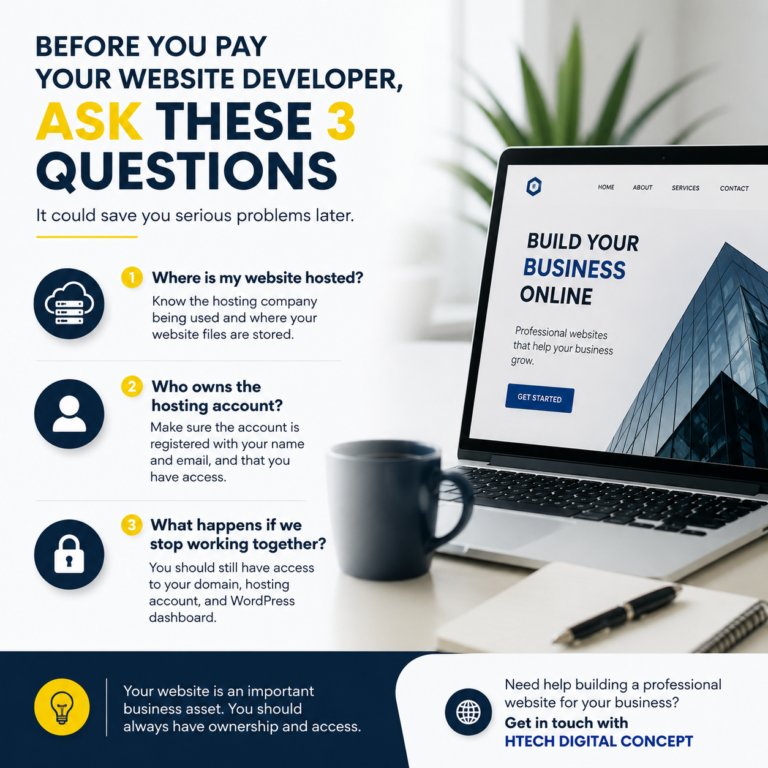
Ongoing Maintenance A website is not a one-time project. It requires regular updates, security patches, content refreshes, and occasional technical fixes. If you manage this yourself on WordPress, budget $200 to $1,200 per year in platform costs. If you pay a professional to manage it, monthly maintenance plans typically run $50 to $500 per month depending on the scope.
The Hidden Cost Nobody Talks About
Here is the number that rarely appears in website cost guides — but it is arguably the most important one.
The cost of a website that does not work.
A poorly built website that gets no traffic, generates no enquiries, and builds no trust costs your business money every single month — even if you spent very little to build it. Every potential client who visits and leaves without taking action is lost revenue. Every competitor who outranks you on Google is taking business that could have been yours.
This is why the cheapest website is rarely the most cost-effective one.
A $5,000 website that generates two new clients per month at an average project value of $2,000 returns $4,000 per month — paying for itself entirely in its first ten weeks and compounding value indefinitely after that.
A $500 website that looks acceptable but ranks nowhere, has no clear call to action, and does not build trust — that website has a negative return on investment. You spent $500 plus your time, and the result is worse than having no website at all, because it creates a poor first impression.
When evaluating website cost, the right question is never “how cheap can I get this?” It is “what return can I reasonably expect from this investment, and what do I need to build to achieve that return?”
What a Professional Website Should Include at Minimum
If you are investing in a professionally built website in 2026, here is the baseline of what you should expect to receive — regardless of price point.
A clear, benefit-driven homepage that communicates immediately what you do, who you serve, and what the visitor should do next. A services or offerings page that describes what you provide in terms of outcomes, not just features. An about page that builds personal trust and handles common objections. A contact page with a simple form, your preferred contact method, and ideally a calendar booking link. A blog or resources section — even if empty at launch — ready for the SEO content strategy you should begin publishing immediately after launch.
On the technical side: mobile-first design that looks and functions perfectly on smartphones, page load speed under three seconds, SSL security, basic on-page SEO optimisation for every page, Google Analytics connected, and a Google Search Console account linked and verified.
If a web designer is quoting you for a website that does not include these fundamentals, ask why — or find someone who understands that these are not optional extras, they are the baseline.
So What Should You Actually Budget?
Here is a straightforward guide based on business stage.
Early-stage or pre-revenue business: Start with a clean DIY build on Squarespace or WordPress.com. Budget $200 to $500 for the first year. Keep it simple — three to five pages. Focus on getting something live and professional rather than perfect.
Established business ready to grow: Budget $2,500 to $5,000 for a freelance-built WordPress website with proper SEO foundations, conversion-focused copy structure, and a clear content strategy. This is the investment level that typically begins generating measurable return.
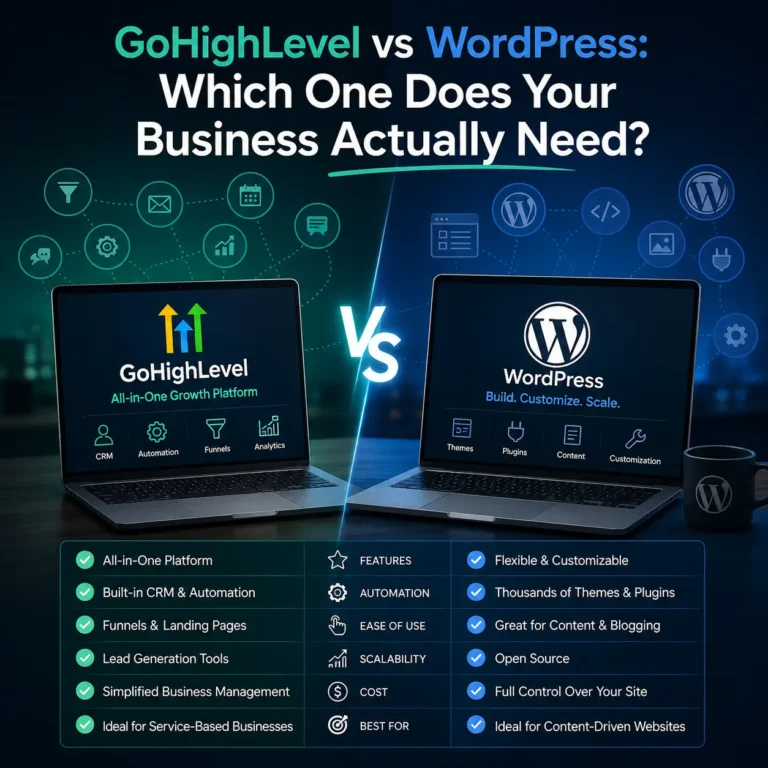
Service business, coach, or consultant serious about client acquisition: Budget $4,000 to $8,000 for a fully conversion-optimised website paired with a GoHighLevel CRM and automation setup. At this level, your website becomes an active client acquisition system — not just a brochure.
eCommerce or complex platform: Budget $8,000 to $25,000+ depending on the scale of your store, the number of products, and the integrations required.
Final Thought
The right website investment is the one that is appropriate for where your business is now and what you need it to do in the next twelve months.
Underspending at a stage when your website is your primary sales tool is one of the most common — and most expensive — mistakes business owners make. Overspending on a complex custom build when a clean five-page site would generate the same results is the other.
Know what you need. Invest accordingly. And measure the return.
If you are not sure what type of website your business actually needs right now, or what a realistic investment looks like for your specific situation, that is exactly the kind of conversation we have on a free strategy call at Htech Digital Concept. No pitch, no pressure — just a clear picture of what your next step should be.
Book your free strategy call here.
Ademola Akinlade is the founder of Htech Digital Concept, a web design and digital growth agency helping businesses worldwide build high-converting websites, sales funnels, and automation systems. Get in touch here.