
Picture this. Someone in your city picks up their phone right now and types “interior designer in Lagos” into Google. Or “event planner Abuja.” Or “web designer Port Harcourt.”
Is your business showing up?
If the honest answer is no or you are not sure — then you are invisible at the exact moment a potential client is ready to spend money. Not tomorrow. Not next week. Right now.
The good news is that showing up on Google does not require running ads. It does not require a massive budget. And it does not require any technical background. What it requires is understanding how Google’s local search system works — and then setting your business up correctly inside it.
That is exactly what this post is going to walk you through.
Why Google Search Matters More Than Any Other Platform for Nigerian Businesses
Before we get into the how, it is worth understanding the why.
Every day, millions of Nigerians use Google to find businesses, products, and services near them. Unlike social media, where people are scrolling for entertainment, someone who types a search query into Google has intent. They are looking for something specific. They want to find it, contact someone, and often make a purchase.
This is what makes Google search fundamentally different from Instagram, Facebook, or TikTok. On social media, you are interrupting people. On Google, people are actively looking for you.
<cite index=”10-1″>According to industry research, 46% of all Google searches have local intent — meaning almost half of everyone searching on Google is looking for a business near them, right now.</cite> For a business in Lagos, Abuja, Kano, or any Nigerian city, this represents an enormous opportunity that most business owners are completely missing.
The businesses that show up for those searches are not necessarily the best businesses in their industry. They are simply the ones that understood how Google works and set themselves up correctly.
Let us make sure you are one of them.
Part One: Understanding How Google Shows Local Businesses
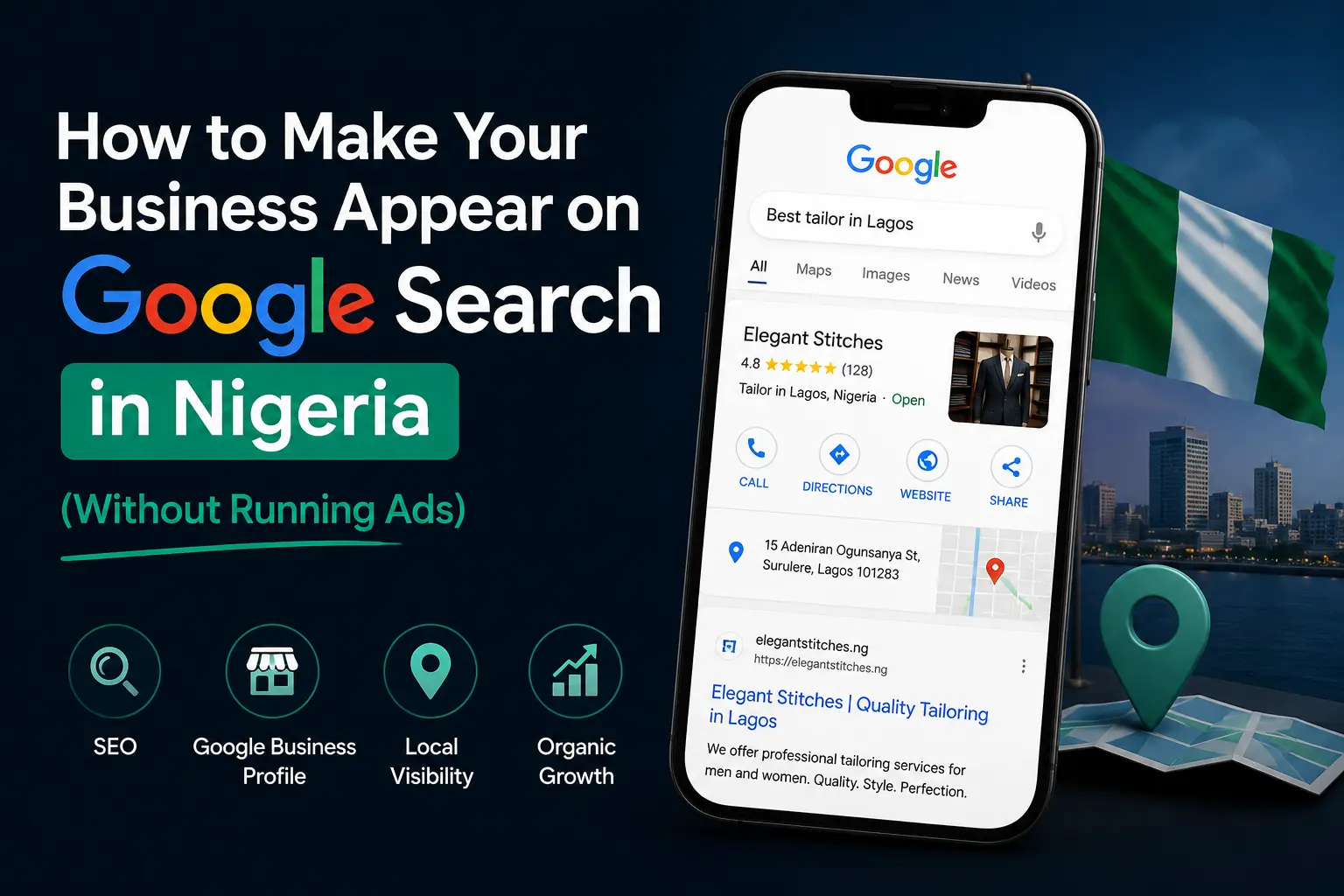
When you type a local search into Google — something like “plumber near me” or “hair salon in Ikeja” — Google typically shows two types of results.
The Map Pack is the block of three businesses that appears near the top of the search results, usually accompanied by a small Google Maps section. This is prime real estate. Businesses that appear here get the majority of clicks and calls from that search.
Organic Results are the regular website links that appear below the map pack. Ranking here requires SEO work on your website — which we will touch on later in this post.
For most local Nigerian businesses, the fastest and most impactful thing you can do right now is focus on getting into the Map Pack. And the way you do that starts with one free tool: Google Business Profile.
Part Two: What Is Google Business Profile and Why You Need One
Google Business Profile (previously called Google My Business) is a free listing that Google provides for every business. When you set it up correctly, your business can appear in Google Search and Google Maps when people search for what you offer in your area.
Think of it as your business’s official profile on Google. It shows your business name, location, phone number, opening hours, photos, reviews, and a link to your website — all on Google itself, without the person needing to visit your website to get this information.
Here is why this matters enormously for Nigerian businesses: many of your potential clients are searching on mobile data. They want a phone number to call or a location to visit. If your Google Business Profile is set up correctly, they can get all of that directly from the search results page — making it extremely easy for them to contact you without any friction.
Businesses with well-optimised Google Business Profiles consistently appear above those that have no profile or a poorly completed one. And yet, a significant percentage of Nigerian businesses either have no profile at all, or have one that was set up carelessly years ago and never updated.
Part Three: How to Set Up Your Google Business Profile Step by Step
Here is the process, broken down simply.
Step 1: Go to Google Business Profile
Open your browser and go to business.google.com. Sign in with your Google account. If you do not have a Google account, create one — it takes two minutes.
Step 2: Add Your Business
Click “Add your business to Google.” Enter your business name exactly as you want it to appear in search results. Select the category that best describes what your business does. This is important — choose the most accurate category because it directly affects which searches your business appears for.
Step 3: Add Your Location
If you have a physical location where customers visit you — a shop, office, studio, or showroom — add your address. Be precise. Use a landmark reference in the description if your address is difficult to find, which is common in many Nigerian cities.
If you are a service-based business that goes to clients (a caterer, plumber, or home cleaning service, for example), you can instead specify the areas you serve without showing a physical address.
Step 4: Add Your Contact Information
Enter your phone number and website address. Use a phone number you actively monitor. Many Nigerian businesses lose enquiries simply because the number on their Google listing is outdated or goes unanswered.
Step 5: Verify Your Business
Google needs to confirm that your business is real and that you are the owner. The most common verification method is a postcard sent to your business address with a code you enter online. In some cases, Google may offer phone or email verification. Complete this step — your profile will not appear in search results until it is verified.
Step 6: Complete Every Section
Once verified, fill out every section of your profile. This includes business hours, a business description, your service areas, your services or products, and your website link. Do not skip any section. Google rewards completeness.
Part Four: How to Optimise Your Profile to Actually Rank
Setting up your profile is only the first step. To rank in the Map Pack above your competitors, you need to optimise your profile. Here is how.
Write a Keyword-Rich Business Description
Your business description is a short paragraph that explains what you do. Most business owners write something generic like “We are a professional company providing quality services to our clients.” This does nothing for your ranking.
Instead, write a description that includes the specific services you offer and the locations you serve. For example: “Htech Digital Concept is a Lagos-based web design and digital marketing agency helping small businesses and entrepreneurs build high-converting websites, sales funnels, and automation systems across Nigeria.”
This description tells Google exactly what you do and where you operate, which directly influences which searches your profile appears for.
Add High-Quality Photos Regularly
Google has confirmed that businesses with photos receive significantly more clicks and direction requests than those without. Add photos of your workspace, your team, your completed work, and anything that helps potential clients understand what you do.
Importantly, keep adding photos regularly — not just once at setup. Google’s algorithm favours active profiles over dormant ones.
Collect Reviews Consistently
Reviews are one of the most powerful ranking factors for Google Business Profile. Businesses with more reviews — especially recent ones — consistently outrank those with fewer.
After every successful job or project, ask your client to leave a Google review. Make it easy for them by sending the direct link to your review page. A steady stream of genuine, positive reviews will compound over time and become one of your strongest competitive advantages on Google.
When clients leave reviews, respond to every single one — both positive and negative. Responding to reviews signals to Google that your business is active and engaged, and it signals to potential clients that you take customer service seriously.
Keep Your Information Updated
If your phone number changes, update it immediately. If your business hours change during public holidays, update them. If you move location, update your address. Inconsistent or outdated information confuses both Google and potential clients, and it can negatively impact your ranking.
Part Five: Beyond Google Business Profile — SEO for Your Website
Google Business Profile gets you into the Map Pack. But to rank in the regular organic search results — the website links that appear below the map — you need to work on your website’s SEO as well.
This is a broader topic that deserves its own detailed post, but here are the foundational steps every Nigerian business website should take immediately.
Use the Right Keywords on Your Pages
Think about what your ideal client types into Google when they are looking for what you offer. “Graphic designer in Lekki.” “Catering service for events in Abuja.” “Affordable apartments in Yaba.”
These are your keywords. They should appear naturally in your website’s page titles, headings, and body content. If your website never mentions the specific city you operate in or the specific service you provide, Google has no way of knowing to show your website for those searches.
Create Location-Specific Pages
If you serve multiple cities or areas, consider creating a separate page for each location. A page titled “Web Design Services in Abuja” will rank for Abuja searches far better than a generic services page that mentions Abuja only once.
Publish Helpful Blog Content Regularly
A Nigerian fashion brand that publishes “How to Style an Ankara Dress for a Work Meeting” will attract thousands of potential customers from Google search every month for free, indefinitely. The same principle applies to any business. When you publish blog posts that answer the specific questions your ideal clients are searching for, you attract highly targeted traffic to your website — people who are already interested in exactly what you offer.
This is not a fast strategy. But it is one of the most powerful long-term growth strategies available to any Nigerian business, at almost zero cost.
Make Sure Your Website Is Fast on Mobile
<cite index=”8-1″>Most Nigerians browse, chat, and buy on phones.</cite> Google knows this, and it prioritises fast, mobile-friendly websites in its search rankings. If your website is slow or difficult to navigate on a smartphone, it will rank lower than competitors with faster, better-optimised sites — regardless of how good your content is.
Test your website on your own phone right now. Does it load quickly? Is the text readable without zooming in? Are the buttons easy to tap? If the answer to any of these is no, your website’s mobile experience is likely hurting your Google ranking.
Part Six: The Consistency Factor — Why Most Nigerian Businesses Give Up Too Soon
Here is the honest truth about SEO and Google rankings: it takes time.
Most businesses set up their Google Business Profile, add a few photos, and then check their ranking two weeks later expecting to be at the top. When they are not, they conclude that “Google does not work” and give up.
This is a mistake.
Google’s algorithm builds trust in businesses over time. A profile that has been active for six months, consistently collecting reviews, regularly adding photos, and keeping information up to date, will outrank a new profile that did everything right in the first week and then went quiet.
Publishing at least 2 to 4 blog posts per month consistently is the kind of disciplined activity that compounds over time. The businesses that commit to this for six to twelve months almost always see significant results. The ones that try it for three weeks and stop see nothing.
Think of SEO as a savings account, not a lottery ticket. The returns are not instant, but they grow reliably over time — and unlike paid advertising, the traffic you earn through SEO does not stop the moment you stop spending money.
A Simple 30-Day Action Plan to Start Ranking on Google
If you want to go from invisible to visible on Google over the next month, here is a realistic plan.
Week 1: Set up and verify your Google Business Profile. Complete every section. Add at least ten high-quality photos.
Week 2: Contact your five most recent clients and ask each one to leave a Google review. Send them the direct link. Follow up once if they have not done it within three days.
Week 3: Review your website’s homepage. Make sure it clearly mentions what you do, who you serve, and which city or region you operate in. Add your city name to your page title if it is not already there.
Week 4: Write and publish your first blog post on your website. Choose a topic based on a question your ideal client frequently asks. Make it at least 1,000 words and answer the question thoroughly.
Repeat weeks two and four every month going forward. The results will come.
What to Do If This Feels Overwhelming
If you read through this and feel like there is too much to tackle on your own, you are not alone. Most business owners did not start their business to become SEO experts. They started it to do the work they are good at.
The good news is that most of what is covered in this post — setting up your Google Business Profile, optimising your website for local search, building a content strategy — is exactly the kind of work I do for businesses at Htech Digital Concept.
I have helped business owners across Lagos and beyond go from completely invisible on Google to appearing in the top three results for their target keywords, without spending a naira on ads.
If you want to find out what your business specifically needs to start showing up on Google, book a free strategy call here. We will spend 30 minutes looking at your current online presence and mapping out exactly what needs to happen next.
Final Thought
Every day that your business does not appear on Google is a day that a competitor is taking the client that should have been yours.
The person searching “your service + your city” right now is ready to buy. They just cannot find you.
Changing that does not require a large budget. It requires the right setup, consistent effort, and a little patience. Start today, and six months from now you will wonder why you waited so long.