

You paid someone to build you a website.
Maybe it cost ₦200,000. Maybe it cost ₦1,000,000. Either way, it’s live. It looks decent. You shared the link on WhatsApp, posted it on your Instagram bio, maybe even printed it on your business cards.
And then… nothing.
No enquiries. No bookings. No sales. Just a website sitting there like an empty shop on a quiet street.
If this sounds familiar, you are not alone. This is the single most common complaint I hear from business owners across Lagos, Abuja, Port Harcourt, and beyond. They have a website, but it is not working.
The problem is almost never what they think it is.
Most business owners assume the issue is their niche, their pricing, or just “bad luck online.” But after working with dozens of Nigerian businesses to rebuild their digital presence, I can tell you the real answer: your website is failing because it was built to look good, not to convert.
There is a difference. And in this post, I am going to show you exactly what that difference looks like — and what you need to change.
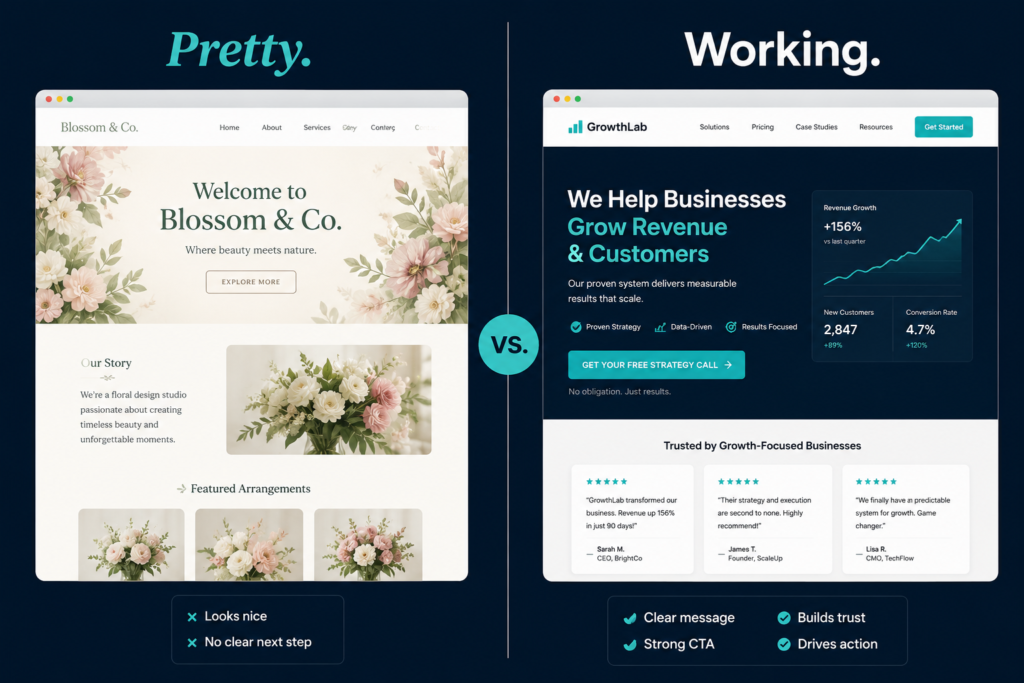
The Difference Between a Pretty Website and a Working Website
A pretty website is designed to impress. It has nice fonts, smooth animations, maybe a slideshow on the homepage. The designer is proud of it. You are proud of it. Your friends say it looks professional.
A working website is designed to convert. Every element on the page — the headline, the layout, the call-to-action button, the testimonials — exists for one purpose: to turn a visitor into a lead, a booking, or a sale.
Most Nigerian business websites are the first type. Very few are the second.
Here is why that matters: a visitor who lands on your website has a short attention span and zero loyalty. Research consistently shows that people decide within the first 5 to 7 seconds whether to stay on a website or leave. If your homepage does not immediately communicate what you do, who it is for, and what they should do next, they are gone — and they are probably going to your competitor.
Let us look at the specific reasons this happens.
Reason 1: Your Homepage Does Not Answer the Right Questions Fast Enough
When someone lands on your website, three questions go through their mind almost instantly:
- Is this relevant to me?
- Can I trust this person or business?
- What do I do next?
Most Nigerian business websites fail to answer any of these questions quickly. The homepage often starts with something like “Welcome to XYZ Solutions — Your Trusted Partner for Excellence.” This tells the visitor almost nothing.
Compare that to a headline like: “I Help Lagos-Based Restaurants Fill More Tables With Google — Without Spending on Ads.”
That headline answers all three questions in one sentence. A restaurant owner in Lagos reads that and immediately knows this is for them, feels the credibility of a specific claim, and understands what the service does.
What to do: Rewrite your homepage headline so it names exactly who you help, what you help them achieve, and ideally where you operate. If your headline could apply to any business in any industry, it is too vague.
Reason 2: Your Website Has No Clear Call to Action
This is one of the most overlooked problems, and it costs businesses a fortune.
A call to action (CTA) is simply an instruction that tells the visitor what to do next. “Book a free consultation.” “Send us a message.” “Get a quote today.”
Without a clear, visible CTA, visitors who are actually interested in your services do not know what step to take. They look around, get confused, and leave — even if they wanted to buy.
Here is what makes this worse: many Nigerian business websites have a CTA, but it is buried at the bottom of the page, or it says something passive like “Contact Us.” By the time a visitor reaches the bottom, most of them are already gone.
What to do: Place a primary CTA above the fold (the part of the page visible before scrolling). Make it specific and action-oriented. Instead of “Contact Us,” try “Book a Free 30-Minute Strategy Call” or “Get Your Free Website Audit.” Tell them exactly what happens when they click.
Reason 3: Your Website Is Too Slow for Nigerian Mobile Users
Here is a statistic that should concern every Nigerian business owner: over 84% of internet browsing in Nigeria happens on mobile devices, often over data connections that are not always fast or stable.
If your website takes more than 3 seconds to load on a mobile phone, a significant portion of your visitors will leave before they even see your homepage.
This is not a theory. Google has confirmed that a one-second delay in page load time can reduce conversions by up to 7%. For a business generating meaningful revenue through its website, that is a serious loss.
Slow Nigerian websites are usually caused by a combination of the same issues: images that were uploaded without compression, too many plugins running simultaneously, themes loaded with animation code that never gets used, and hosting plans that are too basic for the traffic the site receives.
What to do: Test your website speed using Google’s free PageSpeed Insights tool (search for it on Google). If your score is below 70 on mobile, you have a speed problem that is costing you clients. A professional web developer can usually resolve the most common speed issues within a few days.
Reason 4: You Have No Social Proof on the Page
Nigerian consumers are deeply social in how they make decisions. Before trying a new restaurant, people ask friends. Before hiring a contractor, they check referrals. Before buying a course, they look for reviews.
The same psychology applies online. When a visitor lands on your website and does not see testimonials, reviews, client logos, or case studies, their brain registers a silent warning: no one has used this business before, or the business is hiding something.
Social proof is not optional. It is one of the most powerful conversion tools available to any business.
But there is a right way and a wrong way to use it.
The wrong way is generic: “XYZ was very professional and delivered great work. Highly recommended!” — Name, Lagos.
The right way is specific: “Before working with Htech, our bakery had a website but got zero enquiries from it. Three weeks after the new site launched, we had 11 new orders from Google searches alone.” — Name, Owner of [Business Name], Ikeja.
Specific results, real names, real businesses. That is what builds trust.
What to do: Reach out to your five most satisfied clients and ask them one question: “What specific result did you get from working with me, and what would you tell someone who is considering hiring me?” Put those responses on your homepage and service pages.
Reason 5: Your Website Is Not Showing Up on Google
This is the hardest truth in this list.
You can have the most beautifully designed, perfectly written, lightning-fast website in Nigeria — and if it does not rank on Google, almost no one will ever find it organically.
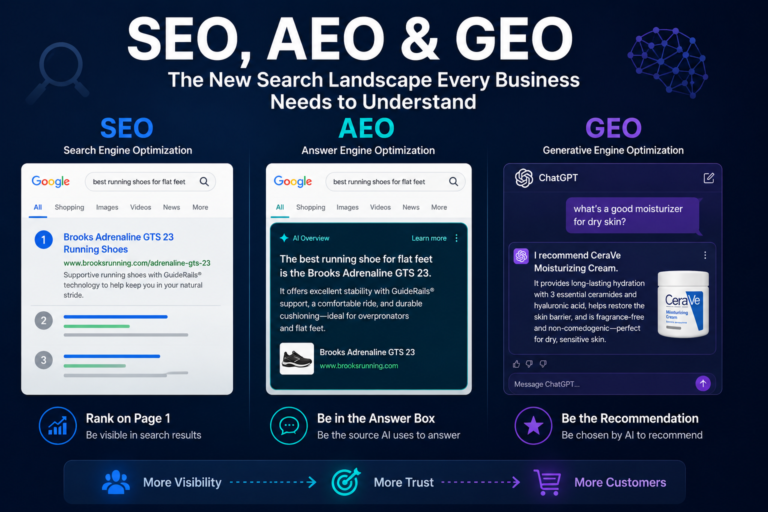
Search engine optimisation (SEO) is the process of making your website appear when potential clients type relevant keywords into Google. For example, if you are an event planner in Abuja, your ideal client is someone typing “event planner in Abuja” or “wedding decorator Abuja” into Google. If your website does not show up in those results, you are invisible to that buyer at the exact moment they are ready to pay.
Many Nigerian websites have no SEO whatsoever. No keyword research. No optimised page titles. No meta descriptions. No blog content. Nothing that signals to Google what the website is about or who it should be shown to.
This is why your website can get almost zero organic traffic while your competitor — sometimes with a worse-looking website — appears on page one.
What to do: Start with the basics. Make sure every page on your website has a clear, keyword-rich title and meta description. Create a Google Business Profile if you serve local customers. And begin publishing blog content (like this article) that answers the questions your ideal clients are actually searching for on Google.
Reason 6: Your Website Describes What You Do, Not What the Client Gets
This is a copywriting problem, and it affects the majority of Nigerian business websites.
Most websites are written from the business owner’s perspective. They describe services, list features, and explain processes. What they rarely do is speak directly to the client’s situation — their frustrations, their goals, and the transformation they are looking for.
Compare these two versions of the same sentence:
Version A (Feature-focused): “We offer professional WordPress website design and development services using the latest tools and technologies.”
Version B (Outcome-focused): “We build websites that bring you paying clients from Google — so your business keeps growing, even when you are offline.”
Version A tells the visitor what the business does. Version B tells the visitor what they will get. The second version is far more persuasive because it connects the service to the client’s actual desire.
What to do: Go through every page of your website and ask yourself: “Am I describing what I do, or what my client gets?” Rewrite any sentence that focuses on your process or your tools. Replace it with the outcome the client experiences.
Reason 7: There Is No Follow-Up System After the First Visit
Here is a reality of online business: most people do not buy or hire on their first visit to a website. They browse, they compare, they think about it, and they come back later — or they forget entirely.
Businesses that win online are the ones with systems to follow up. This could be an email list where visitors sign up in exchange for something valuable. It could be a retargeting ad that shows up on social media after someone visits your website. It could be a chatbot or booking system that starts a conversation the moment someone lands on your page.
Without a follow-up system, you are relying entirely on the small percentage of visitors who are ready to buy on the very first visit. That is a significant percentage of potential revenue left on the table.
What to do: Add at least one lead-capture mechanism to your website. The simplest option is a free resource — a guide, a checklist, a short video — that visitors can receive by submitting their email address. Once they are on your list, you can continue building trust through consistent email communication until they are ready to hire you.
Putting It All Together
Let us summarise what a website that actually works looks like versus one that does not:
| What a Working Website Does | What a Failing Website Does |
|---|---|
| States clearly who it serves in the headline | Opens with a generic welcome message |
| Has a specific, prominent call to action | Has a vague “Contact Us” link buried in the menu |
| Loads in under 3 seconds on mobile | Takes 6–10 seconds on an average Nigerian data connection |
| Shows real testimonials with specific results | Has no testimonials, or only generic ones |
| Ranks for at least a few relevant search terms | Gets zero organic traffic from Google |
| Speaks to what the client gains | Describes what the business offers |
| Captures leads and follows up automatically | Relies entirely on first-visit conversions |
If your website falls into the right column for most of those points, you now know why it is not bringing in clients — and you have a clear roadmap for what to fix.
Where to Start
If reading this has made you realise your website has several of these problems, do not try to fix everything at once. Start with the two highest-impact changes:
First, rewrite your homepage headline so it speaks directly to who you serve and what they get. This alone can meaningfully improve how long visitors stay on your page.
Second, add a visible, specific call to action above the fold. Tell visitors exactly what step to take and what happens when they take it.
These two changes cost nothing to make. They require no technical skill. And they can start improving your results within days of being implemented.
If you want a more comprehensive solution — better design, SEO, automation systems, and a website that works as a full client-acquisition machine — that is exactly what I build for businesses at Htech Digital Concept.
But whether you work with me or not, the information in this post is enough to start making meaningful improvements to your website today.
Final Thought
Your website is not a digital business card. It is not a portfolio you set up once and forget. It is — or should be — your hardest-working sales tool. One that operates 24 hours a day, seven days a week, finding and converting clients while you focus on delivering your service.
The businesses that understand this are pulling ahead. The ones still treating their website as a checkbox are losing clients to competitors who have figured out the game.
Which side do you want to be on?